Nuclear

Nuclear is an anagram of unclear. And ‘unclear’ is just one word to describe Australia’s position when it comes to harnessing the power of the atom. Better words might be ‘confusing’, ‘contradictory’ and ‘bizarre’.
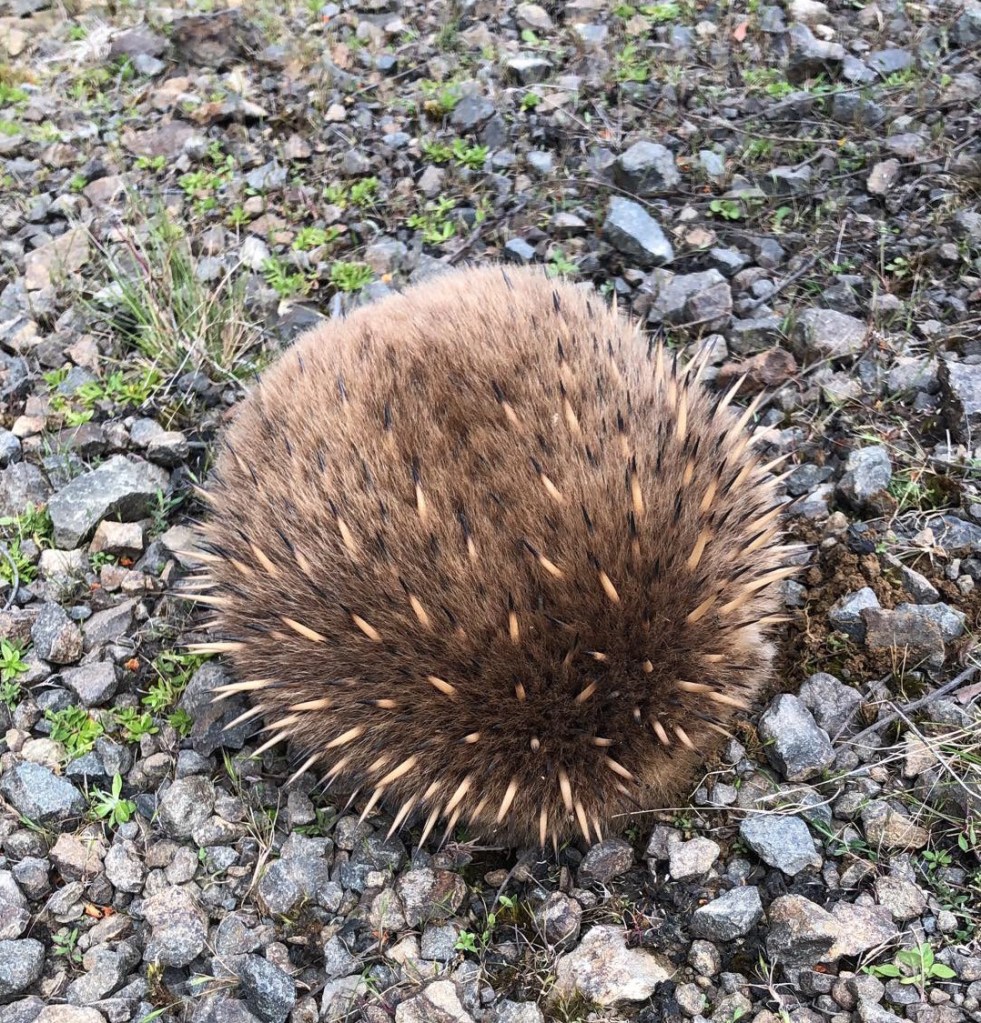
Why do we need expensive subs when this spiky little creature could frighten off our ennemies ? No Echidnya. © Rosie Wooley

For a start we possess a staggering 40pc of the worlds known reserves of uranium plus a well-established mining and export industry. But in 1998, given Australia’s abundance of cheap coal-fired electricity, the Howard Government agreed to ban nuclear power plants. Although it was mere political horse-trading in a tight parliament, it left Australia, as the world’s third biggest exporter of uranium, almost completely devoid of nuclear technology.
Today Howard does not take any pride in that legacy and he is now an advocate for nuclear power. But that would take another Act of Parliament.

Howard is not alone. Now that Old King Coal is losing his throne the Morrison government has asked the House of Representatives Standing Committee on Environment and Energy to look at nuclear power again.
Whatever your position on climate change, what has certainly changed since the nineties is the climate of opinion. A growing number of climate scientists including the IPCC (the Intergovernmental Panel on Climate Change) are now thinking the dangers of going nuclear are outweighed by the dangers of not going nuclear.

But the question the government needs to resolve is price. On the surface nuclear power looks expensive as well as quite possibly dangerous were something to go wrong.
But in its favour the nuclear option would provide reliable 24-hour emissions-free power.
Proponents argue the vast ancient and stable landmass of Australia has remote locations to accommodate reactors and waste disposal. It need not be in anyone’s backyard.

Then there are the jobs that come with mining and nuclear power generation plus the development of technical proficiencies in a country that cannot even make cars or outboard motors.

Yes, we have heard all these arguments before.
I am advocating nothing more than that you might familiarize yourselves with the debate because we are going to have it again. When the big end of town, including finance, insurance, mining and construction companies say we need to get off coal then you can be sure nuclear power will be somewhere in the mix.

Such a decision should be informed by science. It can hardly be a moral issue as it was back in the Cold War. Ethics can hardly be of consideration in a nation that considers nuclear power unsafe but exports 10,000 tonnes of uranium to a world that can’t get enough of it.
Right now, we are like the Big Tobacco bosses who in my experience don’t smoke for health reasons but think it’s fine for you to do so.

Speaking of cigarettes, every year they kill 20,000 people in Australia alone. The nuclear industry likes to report that since its inception, globally 5,000 people have died in nuclear power related accidents. They claim millions more have died from pollution related death as a result of burning fossil fuels.

If those arguments are even halfway sound, there remains one awkward question. In fact it’s a megatonnage of elephants in the room: nuclear weapons.
The capacity to generate nuclear power leads to the ability to produce weapons grade plutonium. Consequently China, France, Russia, Britain, America, India, North Korea, and Pakistan have produced their own nukes. Belgium, Germany, Italy, Holland and Turkey share the weapons through membership of NATO.

Then there is a shadow world of nuke-ownership. The ‘could be’ nations of Belarus, Ukraine, and Kazakhstan.
You could only hope not.

The most interesting case is Israel. That nation is very tight-lipped about its widely presumed nuclear capacity. It takes advantage of what is known as nuclear ambiguity. The deterrence factor (have they or have they not?) protects them from their many enemies without the stigma of being a nuclear armed bully.

It doesn’t always work. When Sadam threatened that he would “rain fire and scorpions” on the heads of his enemies the western allies found justification for invading Iraq. But they discovered no weapons of mass destruction. Only fire and scorpions. It was just a flamboyant manner of speaking.

We don’t know for sure what is the real nuclear weapon delivery capacity of the crazy ‘hermit Kingdom’ of North Korea. But clearly no one is eager to poke the dragon. Not even Trump.

Which raises the question of what would our perceived enemies make of a nuclear-powered Australia? In the new cold war of uneasy diplomacy, names are not always mentioned. So, let’s just call them ‘those whom we hope to deter with $225 b-b-billion dollars-worth of old-fashioned diesel-powered French submarines’.
What would our presumed enemies think about our nukes after they stopped laughing about our subs?

In these alarming times there is no need for further alarm. Whether or not we eventually go nuclear I am sure an Aussie bomb will remain forever an old Holden.

I know you don’t even want to imagine ScoMo or Albo, or whoever comes later, with their finger on the nuclear button.

But it wouldn’t have to be that way. We could save a fortune on defence and go for nuclear ambiguity alone.
No atomic bomb, just the possibility that we are not as harmless as we look. We might even deliberately leak the term, “Project Echidna”.
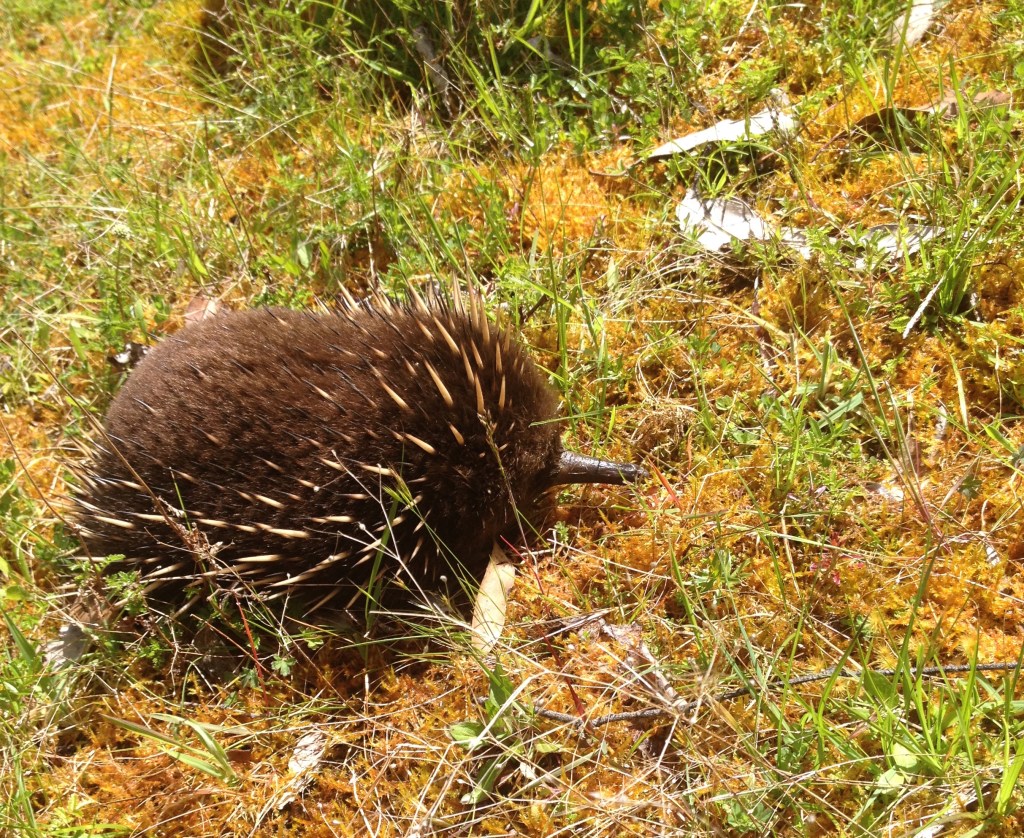
The Echidna. All defense but no aggression. © Rosie Wooley

A harmless amiable marsupial; a danger to ants but would never attack people.
But don’t try to grab hold of it.
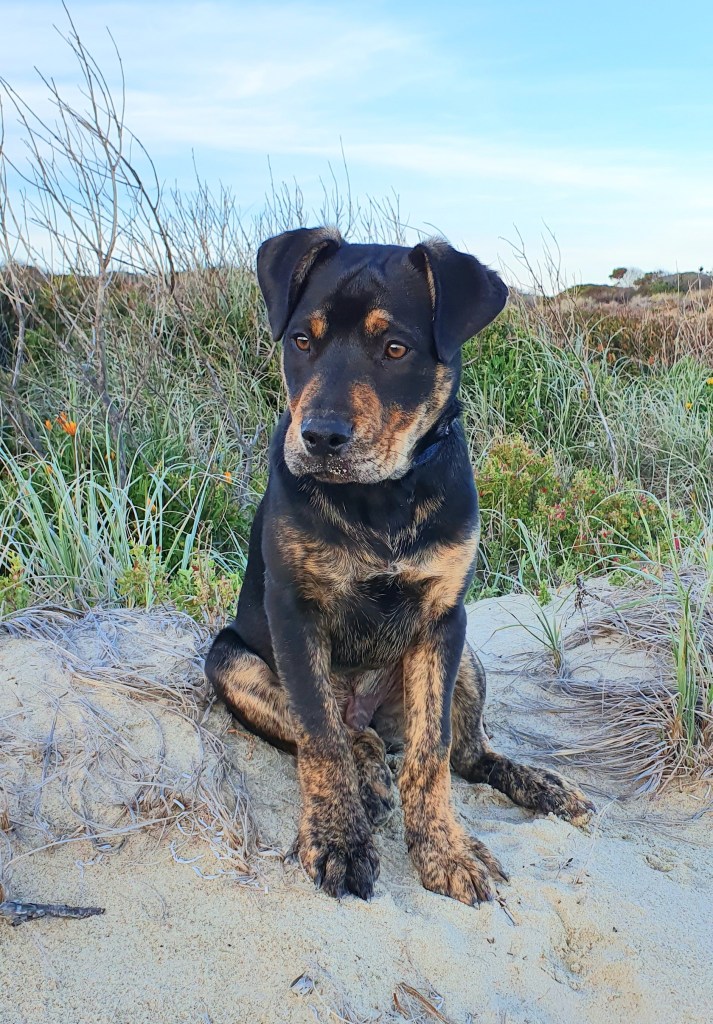
Dusty.

At 6.45 it is still dark. I hear an approaching stampede of many feet and a rapid tick-tick-tick of claws on polished boards. Then comes a desperate scratching slide on a sharp right hand turn into the bedroom. There is a momentary loss of control before the anti-skid braking system takes over. There is the soft thud of a glancing blow to the doorframe but still sufficient forward momentum to barrel across the carpet and launch boldly into pitch darkness.

One giant leap for dogkind.

Dusty the dog, not yet four months old, has achieved his life-long ambition of being able to leap onto a bed. I have never seen him practice developing this skill and assume it must be innate, from somewhere deep down in his doggy DNA.

Until now his early morning territorial demands have been negotiated by whimpering and looking unbearably cute.

But now he can jump onto the bed.

A great leap for a dog but I suspect a small and possibly backward step for a man.

He landed on my chest which would have been a terrible shock had I not been alerted by his boisterous approach.

A couple of days earlier at his checkup the vet weighed him in at 14kg. On impact I would have said the dog was punching well above his weight.

Welcome to the World of Dog and in these unhappy times the best $400 I have ever spent.

The vet warned that Dusty was about to have a growth spurt and should catch up with his gangling long legs and ridiculously big feet. Seven weeks ago, when we got him he was only 3.5kg. Since then he has twice doubled his weight and outgrown his sleeping pad and his food bowl.

For the first couple of weeks he had big feet and tiny little legs. He ran with the rocking-horse gait of a Tasmanian Devil whom he closely resembled. Then overnight he grew long legs and now he lopes like a Thylacine.

But his feet continued to grow, remaining way out of proportion with the rest of him. In the bush he resembles a small FWD on oversized tyres.

Day one, 8 weeks old.

Dusty loves the bush. It is full of wondrous new smells and a large choice of animal scat. He finds wombat and wallaby quite acceptable but horribly his preference is for possum.

I know copraphagia is an unattractive habit. I’m doing my best to dissuade him and will take any advice you can give me. He doesn’t eat his own which I am told is a good thing.

Though if he did, at least would both know where it came from and what he was getting.    

Dusty’s head and face are also widening and while the people he delights still remark on what a lovely puppy he is, I think I see something else coming.

There is an old Australian description, ‘head like a robber’s dog’; as in, “He’s a beaut bloke but mate he’s got a head like a robber’s dog!”

Whatever a puppy is going to become you might expect some early warning from his parentage. We got Dusty from Dogs’ Homes of Tasmania and his papers indicate he is Bulldog/Sharpei X Kelpie.

I doubt Dusty is the intentional product of careful breeding but then how many of us are?

From the British Bulldog I might expect Churchillian resolution and courage. (He is crazy-brave with bigger dogs and resolute in his bad habits).

The Shar-Pei was originally bred in China as a palace guard. The breed is said to be suspicious, reserved and loyal. (No match. He is up for everything and is everyone’s friend).

Dusty doesn’t much look like a Bulldog. He has no trace of its distinctive pushed in nose. Nor does he look much like the deeply wrinkled and loose-skinned Shar-Pei.

But he does look a lot like a Kelpie, the smart and active Australian sheepdog which musters and droves instinctively and requires little training in that skill.

In fact, I am trying to figure out how to discourage him working me like a mob when we go walking. He nips at my heels to get me going and then darts in front to bite at my toes to change my direction.

He’s got the Kelpie’s fun-loving nature and its black and tan markings but not the trademark pricked ears.

With his drooping soft velvety ears and his tan eyebrows, many people who meet him are reminded of the Rottweiler.

Whatever his parts their sum-total makes Dusty an absolute charmer. Donna, my wife, has never much liked dogs and is not always easy around them. But she has fallen big-time for Dusty. He has wormed his way into her heart and sometimes onto the sofa but so far not into the bed.

Short of a DNA test, Dusty’s immediate antecedence will remain a mystery but it hardly matters. Fifty thousand years ago, like every dog on earth, his forebears were  Eurasian grey wolves. The greater mystery is in fact how and why at least some of them started to interact with our human ancestors, developing a beneficial familiarity and over time becoming man’s best mate.

Fifteen thousand years ago our ancestors in central Europe and Asia were burying dogs with the same kind of care and respect they showed for their own kind; suggesting the close relationship we share now  developed early.

Scientists speculate the adaption worked because although wolves are superior trackers, the killing power of their jaws could never match the effectiveness of spears and arrows. And because humans notoriously waste food it made good sense (and an easy life) to hang out with us.

Who adapted to whom was always going to be a ‘chicken or the egg’ question. 

Like so many recent dog adopters, with nowhere to go and little to do I suspect I have done most of the adapting. My dog wakes his human at 4.30 every morning when he needs a pee, which is serious and most unlikely adaption on my part.

Padding out into the chill predawn dark I still can’t believe I am doing it. I grumble,

“Dusty needs a dog door or a bigger bladder.”

He was easy to toilet train. When he was lighter, I would carry him outside and praise him when he peed. I always rewarded him with a tiny tasty snack which he quickly came to expect. After a week of this, one day he streaked to the door and yelped urgently.

I followed him out, delighted with our joint progress. But as I watched he produced no more than a thimble full.

Then, sitting down and panting eagerly, he demanded his reward.

Clearly one of us had been toilet trained.

But which one?

School daze

The new regime of home-schooling has suddenly brought home to many parents a problem that educators have for years been complaining about. Australia trails the developed world in literacy and numeracy and of the two, numeracy is the hardest to bluff your way, especially if you are presuming to instruct kids who are always such hard markers.


I must confide here that while I get by with words, I trip up on numbers and fall, oh so easily, into the abysmal pit of Australia’s numeracy failure.
I know innumeracy in too many ways to count.


Struggling with the weird arithmetic of parking meters and internet banking, I take little comfort from observing that I am by no means alone.
Nor it seems will things improve for the next generation of kids. The report of the 2018 Programme for International Student Assessment (PISA) showed that in mathematics Australian 15-year-olds were three years behind their equivalents in Singapore.
As with illiteracy, I am assuming the number of our people who are innumerate might be, well, innumerable. In numbers beyond counting they carry their dark secret just as I have. Until now.

I am a complete stranger to algebra. I can barely spell trigonometry. Calculus is something I see the dentist about. A square root is conventional sex. And fractions make me fractious.
Somehow, I muddle through life without any of them. I manage to fill a swimming pool without ever having to let ‘x’ equal the volume of water. I turn on the tap until it’s full. It’s that easy.


And as for treating the water, no need for volumes, proportions or a formula; I just keep adding the chemicals until the water turns blue.
And if the children’s skin changes colour, then I just add more water.
As I said an uncalculating life is that easy.


And yet and yet … there is a niggling concern that perhaps I have missed out on something. I often feel sorry for people who somehow avoided the great works of English Literature. I know they are not unhappy about it, but surely only because they don’t know what they are missing out on. And so it might be for me: the unknown world of numbers surely contains delights, magic, marvels and meaning, all of which I am totally ignorant.

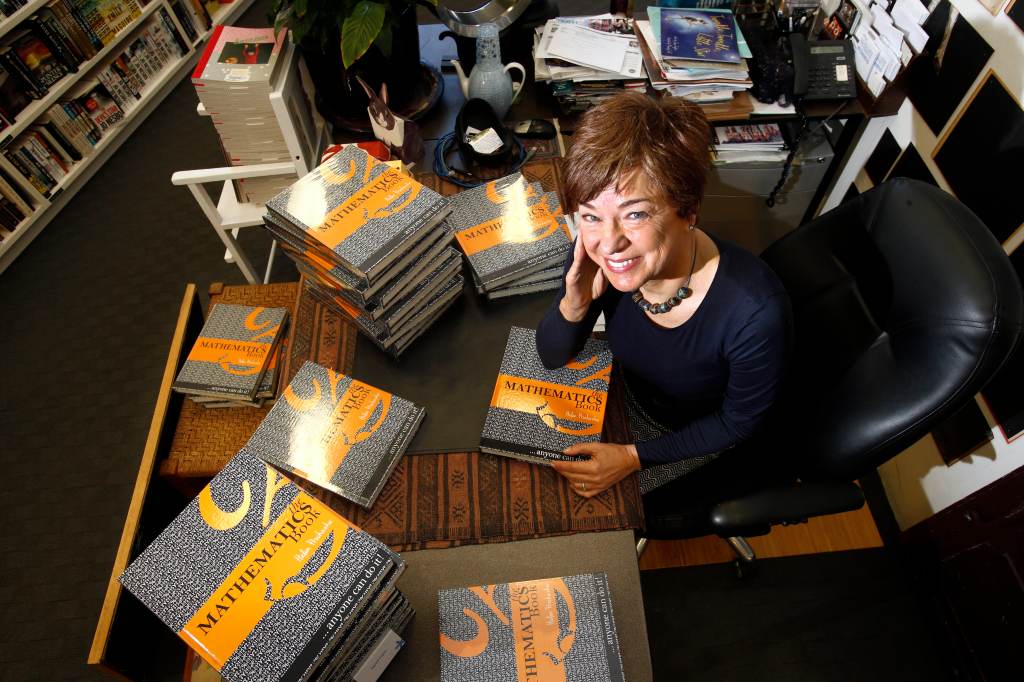
Mathematics teacher and author Helen Prochazka..

Because of the way I am wired I need a book. I need words to explain numbers. And that’s where Hobart author and mathematics teacher Helen Prochazka comes belatedly to my rescue with a book simply titled “The Mathematics Book”. It’s a big, glossy, beautifully illustrated publication about the history and the meaning of numbers.
My eyes have been opened to a whole new world. Albeit a scary one.
In the early pages I learned about the extraordinary life of Fibonacci numbers and their bizarre replication in the whole of nature and in the universe.


How come nobody taught me this stuff a lot earlier?


As a lifelong atheist and math-hater, I find it a bit unsettling that there might actually be a mathematician in the cockpit.
I don’t have space to explain here but Prochazka makes it interesting and as she says, the pictures make it easier.
“I have made it non-threatening. People can get unnecessarily frightened by numbers until they understand them and conquer their fear.” Helen assured me that the subject was by no means beyond anyone’s limited intellect. “The book is set at roughly the year 8 level, but I wrote it for people who somehow fell through the net and can do no more than add, subtract and divide but who would like to understand more.
And now, in the present Caronavirus crisis, it might help parents make a better fist of homeschooling the kids.”

Prochazka explained it wasn’t just missionary work among the numberless heathens that inspired the book. “It was for the many professionals who have to teach mathematics at high school level but weren’t taught properly. I felt sorry for them and wanted to help.”
She refers to those so called ‘out-of-field’ teachers, often PE instructors, who in the absence of trained math teachers, are tasked with a subject beyond their training. “There’s a very limited number of properly trained math graduates coming out every year and the schools have to compete for them.
Helen Prozchazka, says most of her customers are not mere lost souls but are actually, “Struggling mathematics teachers instructing way beyond their capacity.”

Journalist Charles Wooley . At last coming to terms with numbers.


“The Mathematics Book” first came out in Prochazka’s home town of Hobart two years ago and was keenly received. Fullers Book shop in the CBD sold an initial 500 copies making it a Hobart best seller for three months.
“Those were bloody good numbers for a mathematics book,” Helen Prochazka laughs. “For three months not even Helen Garner, Bill Bryson and Richard Flanagan couldn’t knock us off the shelf.”

Now it looks like this book’s hour might have come round again.

The Mathematics Book
Helen Prochazka
Zenolith
Hobart 2017.

“It’s amazing who you might run into on a Sunday afternoon on a quiet country road.”

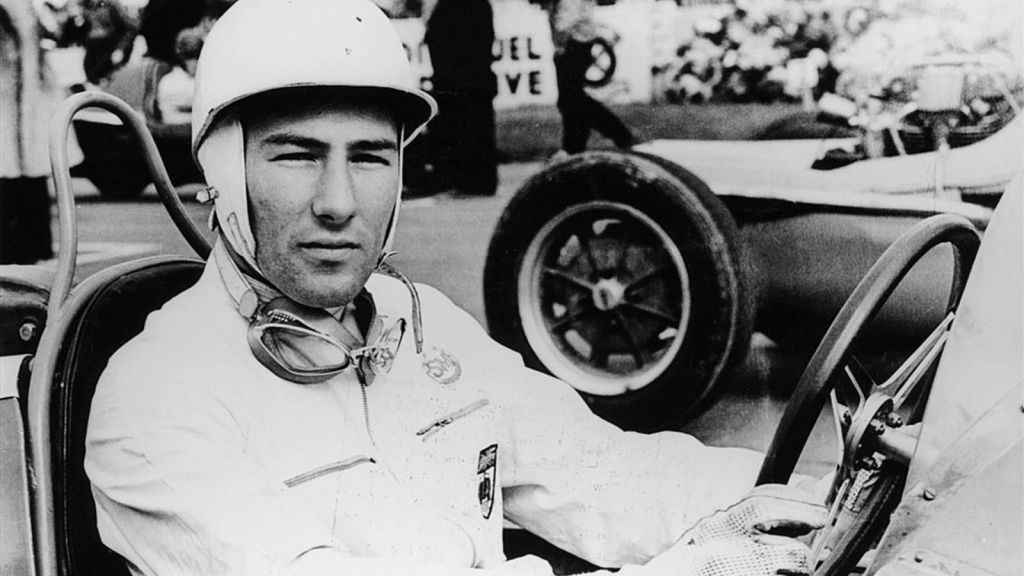
In the 1960s policemen everywhere, would bail up speeding drivers to ask, “Who do you think you are? Stirling Moss?”

Stirling Moss died recently at the age of 90 after a long illness, unrelated to the present plague. He always described himself as happy to be regarded as, “The greatest Formula One Driver never to win the world championship.”

In 1955 Moss at 25 made his claim on world pre-eminence by winning the famous Mille Miglia.

For those of you not into motor racing it is a spectacular 1600km road race through some of the most beautiful country in Italy. Moss finished way ahead of the field beating the world-famous Argentinian, Juan Manuel Fangio by a sensational thirty minutes.

You might have heard of Fangio. His was another name invoked by traffic cops everywhere. As in “Pull over Fangio. Do you know how fast you were going?”

I met Moss once in the eighties in London. A short, slight man, balding and charming, he was with a beautiful young woman who gave every impression of being bedazzled by his charisma and devil-may-care attitude. As were many.

“If you are not trying to win at all costs,” he would often say, “Then what on earth are you doing out there.”

Consequently, the playboy racing driver had as many accidents as girlfriends. He broke both his legs, severely damaged his spine and injured his brain. He suffered lasting nerve damage and impaired eyesight.

Sensibly he quit young, giving up motor racing for a successful business career in property development. He once said, “I knew if I didn’t get out, I’d kill myself and maybe someone else.”

And with that thought (having exhausted the sum-total of my knowledge of motor racing) comes the time to shift gear to the year 1992 and a tale about colliding worlds and random chance. For you never know who you might run into on a Sunday drive on a quiet country road in the northwest of Tasmania.

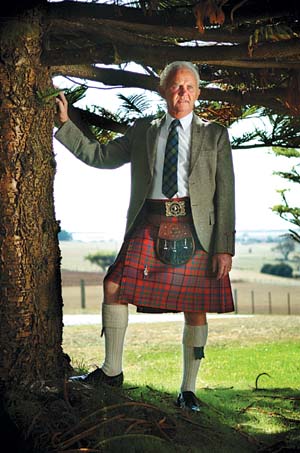
Photo: Phillip Biggs Malcolm Murray 12th Earl of Dunmore at his home at Wesleyvale.

This is the scene as two quite different motor vehicles are closing on one another in peaceful rolling farmland near the tiny town of Moriarty.

One vehicle, a souped-up Ford Falcon is travelling at high speed, past blurred hedge rows and flashes of chocolate brown soil, roaring uphill and down through the green landscape this fine day in early March.

The driver of the Ford is Stirling Moss. He is too intent on memorizing every twist and turn of the narrow bitumen road to notice a familiarity of scenery: how much this pleasant land resembles his own English countryside.

At 150 kilometers an hour on an unfamiliar winding road he’s not here for the scenery. He is here to win an upcoming race and for that he needs to practice. In the coming days he will need to know every twist and turn.   

Moss has been in Tasmania only a few hours, having flown from London and is likely tired and jetlagged and in need of rest.

But always he has that rule; “If you are not trying to win at all costs then what are you doing here?”

The other oncoming vehicle, a modest Toyota Corona (again unrelated to the present plague) is travelling at a much more sedate speed. The driver who is only five minutes from home is accompanied by his wife. They have enjoyed a rare weekend away together without the kids and are in no hurry to get back.

The Corona is doing only 80 kilometers an hour, almost half the speed of the Falcon but the closing speed of the two vehicles is 230 kilometers per hour.

The head-on collision destroys both cars. But it is the occupants of the smaller Toyota Corona who are most seriously injured.

Stirling Moss’s premonitions about what might happen if he continued to race have almost come true.

Moss was in Tasmania for the 1992 inaugural Targa Tasmania which he was fully expecting to win, driving the not yet released new Ford Falcon XR8.

It was to be a great coup for Targa Tasmania and even bigger for his sponsor Ford Australia. But the grand plans suddenly ended with a car crash. 

This week the driver of the Corona, Malcolm Murray told me, “No one knew Stirling was here, least of all me. It was all supposed to be a big surprise. A secret marketing strategy. Out of nowhere Stirling Moss would win Targa and the XR8 would be launched with a huge fanfare. At least that was the plan.” 

Malcolm Murray, to this day has no recollection of the accident from which he and his wife took years to recover.

Malcolm was a local electrical engineer and a pilot- instructor, married to wife Jan and with two kids.

“But,” as they say in the steak-knife commercial, “There is more!”

The bloke Stirling Moss cleaned up that sunny March day on Bonney’s Hill at Moriarty also turned out to be Sir Malcolm Kenneth Murray, Chief of the Scottish Clan Murray and the twelfth Earl of Dunmore.

Tasmanian born Malcolm inherited a British peerage which entitled him to sit in the House of Lords in Westminster. Accordingly, his wife Jan became the Countess of Dunmore.

In political reforms during the Blair era the British Government abolished hereditary seats in the House of Lords.

Malcolm retained his titles but lost his seat after making only two speeches in the House; one when he took his seat, the other when he gave it up.  

Jan’s death five years ago was unrelated to the motor accident but according to Malcolm she never fully recovered. “Whenever we were out driving and a car approached, she became alarmed that we were going to have a head on.”

For his part, Malcolm considers himself lucky. “I don’t remember a thing about the accident. I’m a pilot and when I woke up in hospital all strapped up, the first thing I asked was ‘Whose plane did I crash?”

Malcolm was unconscious when the police arrived and had to be cut out of the wreckage. But he does remember and believes to be true, the wonderful story that did the rounds at the time.

The crash scene told the whole truth. It was clear the Ford was on the wrong side of the road and travelling much too fast.

So, the indignant traffic cop approached the driver of the XRB and asked the classic question.

“Mate, who do you think you are? Stirling Moss?”

The driver sheepishly replied, “Well actually …….”

Later in court Stirling Moss had a conviction recorded for failing to keep to the left.

He never returned to Tasmania.

Malcolm Murray still avoids the backroads during Targa.